Text Size

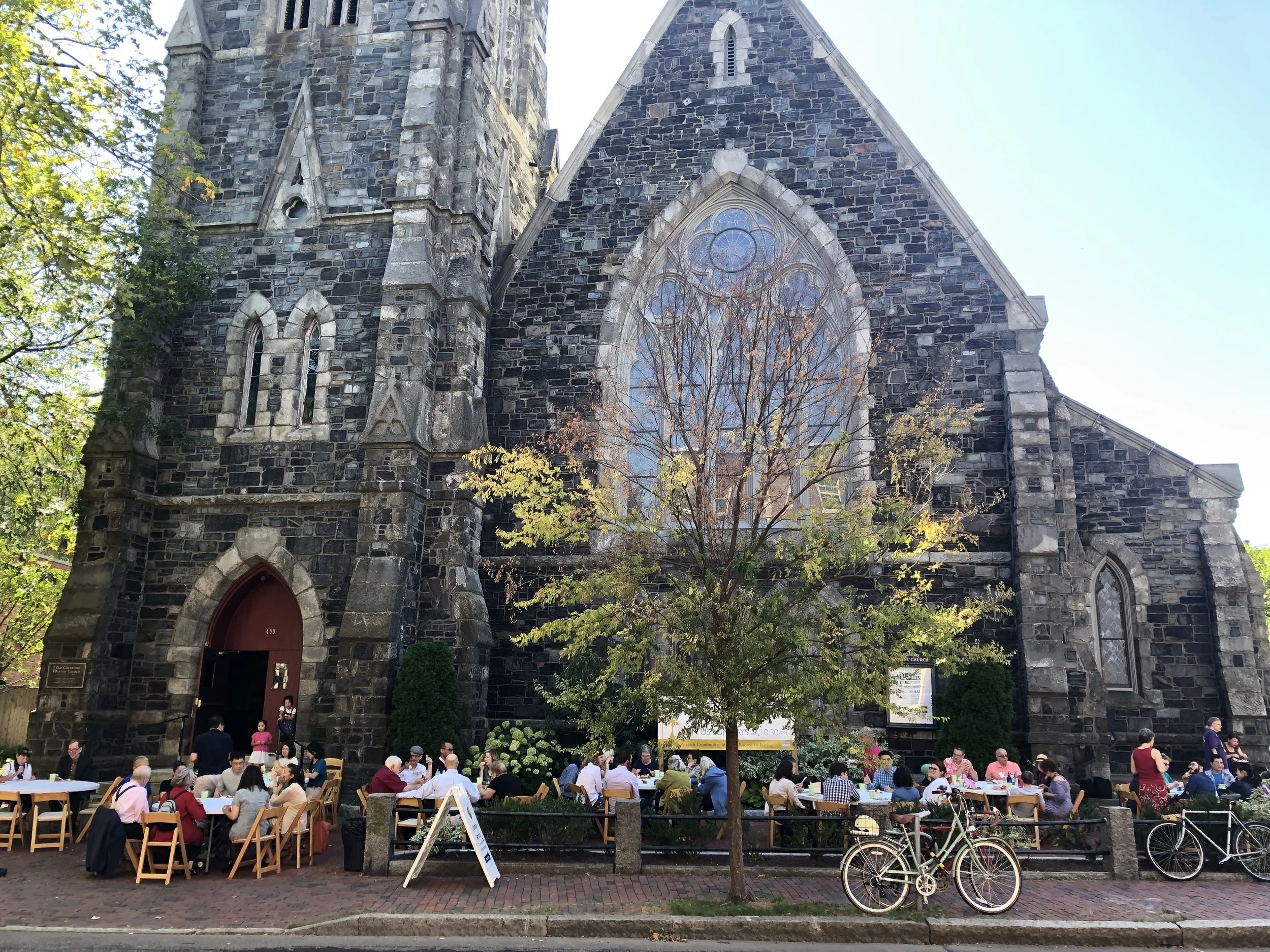
Thinking of Visiting?

Address
1151 Massachusetts Ave.
Cambridge, MA 02139
map and directions

About the Service
Sunday morning services begin at 10:30 a.m. year round

Services last about an hour and are followed by a time for us to meet you over coffee and cookies.

Child Care
We have a wonderful Sunday School & Child Care program offered during our service.

The children begin the service with the congregation and adjourn to the Christian Ed. room following the Children's moment.

Music
We offer a wide variety of music throughout the year drawn from Cambridge and Boston's finest artists and our very own OCBC Choir.

Sermon: The Eyes of Babylon Are Upon Us

 “The Eyes of Babylon Are Upon Us.”

A sermon preached from the pulpit of Old Cambridge Baptist Church

by the Reverend C. Irving Cummings, Pastor, on May 31, 2009


Pentecost

Text:  Acts 1: 1-21

 Do you know that before the time of Moses there was an empire whose mathematical achievements resulted in our common reckoning of time as sixty seconds in a minute, sixty minutes in an hour?  These people developed crystal lenses with which they observed the universe, and glass to make vases.  They wrote a diagnostic handbook for physicians which carefully described symptoms and stages of diseases, prescribed thorough examinations of patients, proposed effective treatments of bandages, creams and pills, and listed probable outcomes which are still accurate today. 

 Before the time of Moses. 

 Most of their towns held libraries; they produced interlinear translations of documents from neighboring cultures, contrasting their own language with that of the original sources.  Their codifications of law became the foundation of much of English Common Law, and, thus, serve as the foundation of much of American jurisprudence.  Their understanding of astronomy was extensive.  They developed philosophy from empirical observation, and thus, they provided the basis for the scientific revolution of the eighteenth and nineteenth centuries.  They had industries of metalworking, copperworking, glassmaking and textile weaving.  They made lamps for artificial lighting.  Their architecture was unparalleled in its time.  They learned how to harness the power of water and to control floods, while storing it for irrigation in times of drought.  They gained unprecedented understandings of agriculture and floriculture.  They had a highly developed system of commercial trade.  Their upper classes lived in lovely homes.  The were adept at decorating with copper, bronze and gold, and they built advanced armor and weaponry for defense of their cities.   Their temple towered over the rest of their capital city, and could be seen for miles in the distance. 

 Before the time of Moses.

We might well ask, “Who were these people?  Why do we know so little of them now?” 

 They were, of course,  the Babylonians.  In 539 BCE, their empire fell to Cyrus the King of Persia,  he for whom the Prophet Jeremiah urged the people to pray, and he who freed the ancient Hebrews to return to their homeland. 

 He conquered them with an unprecedented and clever military maneuver. The famed walls of Babylon were indeed impenetrable, with the only way into the city through one of its gates or through the Euphrates, which ebbed beneath the thick walls.  Awaiting an evening of a national feast among Babylonians, Cyrus' troops diverted the Euphrates river upstream, causing the river to drop.  The Persians then marched under the walls and conquered the city while the drunken Babylonians at the center were oblivious to the breach.

 Herodotus, the fifth century Greek historian, and even our own Hebrew Bible describe the capture. 

 Then, two hundred years after that, a twenty-five year old Macedonian commander known to history as Alexander the Great, defeated the succeeding king of Persia, and Babylon fell to the Greeks and by the time of the birth of Christ, there was nothing left but desolation and obscurity. “How are the mighty fallen.”

 My thanks to playwright Jeff Key for the inspiration and for and the title of this sermon.  During his deployment as a United States Marine in Iraq, he found himself within sight of the rubble that remains of the great empire.  I cannot imagine what that experience must have been like.  But, if the name of his play suggests, being there, and under those circumstances, must have changed his life.  The centerpiece of the play is the phrase:  “The eyes of Babylon bear witness . . .”

 The dominant narrative of our politicians and our people in the United States is that we are the most advanced country and culture that ever lived—that is, when we pause to think about it--which is rarely. 

 Most Americans consider our nation to be at the top of the political and cultural pyramid, that is what we are taught, and, as a country, we are willing to spend our tax dollars, our children’s lives, and our political capital on maintaining that point of view.  Each name on our list of war dead today is someone’s child, let us remember.

 Yet, the Bible is clear about what becomes of such pyramids.  The zigguarat of Babylon is but one example.  God perceives that the people have become too proud of their abilities, and so God intervenes merely by confusing their tongues, so that they can no longer understand one another, and their speech becomes mere babble. 

 Tellingly, our government invaded Iraq with forty thousand troops and five people who could speak the language of the Iraqis, Five people who could speak beyond what the Iraqis must think of as mere babble, but babble defended with guns.  Five people.

 Jeff Key adds the observation at the foot of the rubble that was Babylon, “America, you stand at a threshold.  Will you live to the ideals on which you were founded, or will you go the way of every empire before you . . .?”

 Let us look again at the story of Pentecost, the mirror image of Babylon.

The Lucan author, also the author of the Book of Acts, tells of an overwhelming awareness, in the group that had gathered, of the presence of the Spirit coming upon them in a way that led to an ecstatic and joyous response.  With the skill of an artist, Luke reshapes this memory so that its abiding significance is there for all to see. The crowd has come together from all the nations around. All hear the gospel in his or her own language. Here the curse of Babel is overcome. There human pride and ambition built a tower, only to see it collapse and people came to be scattered and no longer able to understand one another’s language.

But, here, here at Pentecost, the barriers of mere speech have been broken down, Communication is restored. The Spirit creates the miracle of unity. 

Doug Koch, last  Sunday, spoke of the church not belonging to Paul or Appolos, or Cephas, but belonging to Christ.  That’s what’s going on at Pentecost, too.  All the many little groups whose names we pronounce in the appointed reading for this day, all with all their possibilities for balkanized identity, all give way from the point of view of their individual peculiarities,  to the possibility of mere humanity in Jesus Christ.  My sociology of religion professor, Peter Berger, used to say that culture is a language with a navy.  How true that is, we need only hear the evening news to understand +. 

But ancient Jewish tradition had it that at the giving of the Law on Sinai a great flame came from heaven and divided into seventy parts, one for each of the nations of the known world at that time, and each understood the Law in his or her own language. Luke uses the imagery of this tradition to give profound symbolic coloring to the Pentecost event. Here,  the tongues of flame alight on the one hundred and twenty and the message of the love of God is heard by Jews from every land.  Let’s not worry, now. about the possibility of singed hair as the flames descend or wonder why they didn’t simply use the language that all the visitors would have understood, namely Greek. Luke is saying, here, that the coming of the Spirit is as epoch making as the giving of the Law, the scripture on Sinai and more. Here is the love of God for God’s people in every land wherever they have been scattered and through them for all people everywhere to the uttermost parts of the world. The Spirit will make all this possible.

These symbols of flame and dove and mutual comprehension spoke more powerfully to those early churches still grappling with their Jewish roots than they do perhaps for us, in our own day. They would have recognised the imagery. They would have read of forty days of appearances and thought of Israel’s forty years in the wilderness. They would have immediately seen the symbolism in the number twelve and the number of a hundred and twenty. Here was the new turn in destiny.  Praise God that already now God has poured out this advance installment, the Spirit. These ecstatic men and women are not drunk as you might have thought. They were full of the joy of the promised Spirit.

But this is much more than the celebration of the earliest Jewish Christians at the Pentecost festival. It is also the Church’s festival for Luke’s day and it is our festival. In it we celebrate the coming of the Spirit, then and now and in every age.

The word Spirit has a fascinating range of meanings: “ruach,” breath, wind, “pneuma,” spirit, soul. The mighty rushing wind plays on this range of meaning. At the creation the Spirit moved over the face of the waters. That may be a correct translation. An alternative is to say: there was a tremendous storm over the deep. Spirit is about power, force, energy, life giving power. Spirit may also connote breath, life giving breath. God breathed into the human being; it became a living person. In Ezekiel’s vision God’s breath blows upon the dry bones and they live.

Whatever we call it, it is people trusting each other enough so that our basic humanness is understood beyond local ideologies, political commitments, personal peculiarities, sexual orientations, ethnic and racial differences.

Talking about Spirit is talking about God, God in power like the force of a wind, God in intimacy like breath. Sometimes the power of divine presence overwhelms us; we may shudder and shake quite literally; we may shout and cry aloud; we may sing for joy; we may extol God in tongues of praise; sometimes the power of divine presence brings to us a stillness, silences us, takes from us all forms of speech. It doesn’t matter when or how we respond to the Spirit. It matters that we respond to the Spirit. As the Spirit of creation produced a bewilderingly diverse creation, so the Spirit who comes to us produces a rich diversity of responses in human beings. The Spirit by which God drove Jesus into the wilderness and then back into the poverty of Galilee, the Spirit that came upon Jesus enabling him to announce the vision of the kingdom and to live out its agenda during his ministry; this same Spirit takes us to the place of testing and directs us to the world’s Galilee; this same Spirit lifts our eyes to the vision and our hearts and hands to its agenda of love in the world. The fruit of this same Spirit in Jesus and in the Church is love, is the living out of the agenda of the kingdom.

The Spirit strikes us in many ways; and the time of the Spirit is always.  It is the what that matters: namely, that we live in openness to the vision of the Commonwealth of God and to the power and intimacy of the Spirit of the Commonwealth manifesting itself in love.

Ultimately to talk of the Spirit is to speak of God and to speak of being filled with the Spirit is to talk of being filled with God. Or to put it in other words, to let God rule fully now into our lives, to let the Commonwealth of God be what it needs to be now in us and among us.

This is the opposite of the pride and arrogance of Babel, though its eyes remain upon us.  This is not about intellectual or philosophical achievement.  This is not about the “banking” system of education in which we fill ourselves up in order to put those who are not thus filled underneath us. 

This is not about our military or economic prowess or intellectual or engineering acumen.  This is not about identity politics or the things that separate us.  This is about the very Spirit of God, working among us in all sorts of communities of faith.  Not just Christians, not just Jews.  But everybody, understanding and loving one another across our differences.

All the churches, and even this church, are microcosms of that first Pentecost of 120 people who could not hear each other. We, the little gathering of God’s people at 1151 Massachusetts Avenue will either get this, or we won’t. 

We, the most powerful nation on earth, filling the territory between English and French-speaking Canada and Spanish-speaking Mexico will either get this, or we won’t.  The eyes of Babylon bear witness.

In the name of God.  Amen.